Tuesday, April 12, 2011

review: Moon Over the Mountain


Moon Over the Mountain/Luna Sobre La Montana by Keith Polette. Illustrated by Michael Kress-Russick. Raven Tree, 2009 (978-1-932748-85-7) $16.95


A traditional Asian folk tale about a man who seeks greater and greater power is dressed up here with a southwestern setting, embedded Spanish, and some very eye-catching illustrations.

Agipito is a poor stonecutter who must work very hard cutting piedras. One day Agipito wishes he could be a rich merchant; the Spirit of the Desert grants his wish and he wakes up as a comerciante rico. Agipito is contento... until he notices how much stronger the sun is.

I appreciate multilingual books with embedded language and this one is well done, with the words always following an introduction of the English, for clarity. "Day after day, he cut out stones for large houses and churches. Many casas grandes and iglesias were built with these piedras. (The Spanish words are printed in red.) The book would be enjoyable just for the text, but it's the illustrations that really make it -- rich, bold, expressive depictions of Agipito as el sol, el viento and la gran montana.

I was bothered by the book's ending, which disrupts the obvious circular nature of the story for a puzzling happy ending that rings false. It's still a good choice for readers looking for this type of book.

© 2011 Wendy E. Betts

FTC disclosure: Review copy provided by the publisher. This blog is completely independent, but I receive a small percentage if you order books from Powell's via this site.

Labels: , ,

Tuesday, May 26, 2009

review: Hello World


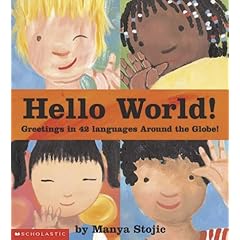
Hello World written and illustrated by Manya Stojic. Scholastic, 2002 (0-439-36202-4) OOP (scheduled to be reprinted in paperback in 2009; many used copies available online)

This picture book could hardly be simpler, yet grabbed me instantly with its potential to inspire interesting discussions about language. Aside from a short introduction, each page is just a large illustration of child's smiling face, the word "hello" in an identified non-English language, and a phonetic spelling. But the way the words are grouped makes it very easy to see intriguing similarities in spelling and/or pronunciation between different languages. Several African, Indian and Asian languages are grouped to show the complete opposite -- that their words for hello are totally disparate from each other. The historica, political and geographic reasons for all this may be too complex to share with young children, but just the idea that even people from the same country may not speak the same language is a useful one. There's an index of languages but unfortunately no information on where each one is spoken.

Fingerpaint style illustrations focus entirely on the children, each of whom is visually distinctive in some small way. I particularly like the vast variety in skin tones; no child looks exactly like another. There's no other detail, and for the most part Stojic avoided outfitting the characters in any ethnically typical (or stereotypical) ways, keeping the focus on what they have in common: their welcoming smiles. (2-4)

Labels: , ,

Thursday, October 02, 2008

review: Marco Flamingo/Marco Flamenco


Marco Flamingo/Marco Flamenco written and illustrated by Sheila Jarkins. Raven Tree, 2008 (978-0-9794462-5-2) $16.95; $7.95 pb

Every year, Marco Flamingo's island paradise is visited by the migratory "snowbirds." Marco is curious and asks them "what's snow?" --but all they'll say is "You don't want to know!" But Marco does want to know, and after spending the night reading up (assisted by some helpful stars and fireflies), he sets off north and discovers a new kind of paradise, one with skating, snow angels, ice fishing and sledding. And he even convinces some of his island friends to come join in.

With its awkward looking, yet ultimately competent and successful hero and a loving depiction of winter, this is a pleasing story that's worth picking up for a unit on winter or for a bilingual read that's pretty much just for fun. The illustrations give attractive natural backdrops for the more goofy looking animal characters, making Marco's first look at a land of snow and ice lovely and satisfying. (4-8)

Also available in English only and Spanish only editions.

(I didn't find any other blog reviews, but here's the author's blog.)

Labels: , ,

Monday, June 16, 2008

review: My Big Book of Spanish Words


My Big Book of Spanish Words written and illustrated by Rebecca Emberley. Little, Brown, 2008 (978-0-316-11803-3) $8.99 board

A typical word book, this one stands out a bit in the crowd because of the vibrancy of its illustrations. Each oversized page features common childhood words in English and Spanish, in categories like "My Colors/Mis colores" and "My room/Mi cuarto." The names of the items are given in thin letters in English and fatter letters in the same color in Spanish, an eye-catching design touch. Cut-paper pictures of the items are simple and easily recognizable, but the bright colors, vivid small details and casual looking layout give them verve. I especially liked the animals page, which features a demure looking cat, a slightly suspicious dog and a pig happily flopped on its bottom. (6 months-3)

Labels: , ,

Monday, March 24, 2008

everything old is new again

I'm learning that it pays to keep books my son likes, even when he seems to lose interest--it often comes back. This is a favorite once again:


Can You Count Ten Toes? by Lezlie Evans. Illustrated by Denis Roche. Houghton Mifflin, 1999; 2004 (0-618-49487-1) $5.95 pb

I would have to like this book no matter what, because it has that all-too-rare and wonderful thing: a pronunciation guide after each word! Luckily, that's not all there is to like. A short rhyming text introduces a different language per page, with various items to count from one to ten in that language; uncrowded illustrations show a cat-person enjoying around-the-world adventures with a group of children. A continent map at the end shows the parts of the world where each language is spoken, including 20 countries for Spanish and 26 for French. An enjoyable book for fans of both language and counting. (3-8)


Can You Greet the Whole Wide World? by Lezlie Evans. Illustrated by Denis Roche. Houghton Mifflin, 2006 (978-0618-56327-2) $16.00

This companion to Can You Count Ten Toes? follows a cat-kid on his first day at school. Short rhymes introduce each new situation he encounters and the phrase required--"good morning," "what's your name?" and so on--and the phrase is then given in 12 languages, with a pronunication guide after each one. Again, a color-coded map at the end shows where the different languages are spoken, an intriguing visual which could potentially spark some interesting discussions. Chunky, simply-lined illustrations have a somewhat flat affect but are attractively bright. (4-8)

Labels: , ,

Friday, January 11, 2008

Poetry Friday: The Moon is La Luna

This book sadly arrived too late for me to consider it for the Cybils shortlist, so I wanted to give it a little love.

Guest review by Ben: "This book is funny."


The Moon is La Luna by Jay M. Harris. Illustrated by Matthew Cordell. Houghton Mifflin, 2007 (978-0-618-64645-6) $15.00

I always appreciate the cleverness of books that integrate Spanish words into an English text, but the short verses in this book go one or two step beyond the usual, working pronunciation and jokes based on it into the mix as well. Here's one of my favorites:

In Espanol, papá means "dad."
("paPA" is how it is said.)
But papa (said "POP-a") doesn't mean "dad,"
It means "potato" instead.
So watch how you say it,
Unless you would like
a Potato to tuck you in bed.

That one almost illustrates itself--but to make it even funnier, it comes right after a verse joking about how una cama (a bed) is pronounced like the English word "comma"; in the corner of the illustration for that page, which shows a boy in bed, we see a potato striding into the room, ready to tuck in the startled boy on the next page.

Aside from an occasional scansion glitch, this is a natural for reading aloud, but the short verses, familiar words, silly jokes and clean, light design make it approachable for beginning readers as well. (It's a shame the cover makes it look so much like a book for toddlers; I hope that won't put older readers off.) Overall, this is a happy marriage of information and humor. A Spanish sounds pronunciation guide and a glossary are included. (4-8)

Labels: , , ,

Monday, November 05, 2007

review: Counting Ovejas


Counting Ovejas by Sarah Weeks. Illustrated by David Diaz. Atheneum, 2006 (978-0-689-86750-7) $17.99

A little boy who's trying to sleep finds himself counting sheep against his will when they start wandering in ever expanding numbers into his bedroom. "Una oveja blanca./One white sheep. Adios, oveja blanca!/Good-bye, white sheep!" says the boy, gesturing the first sheep out of his room. As the groups of sheep get bigger, the boy has to use increasingly strong measures to get them out: "Nueve ovejas azules/Nine blue sheep" are pushed with a bulldozer, and "Diez ovejas amarillas/Ten yellow sheep" are airlifted by the boy in a personal rotocopter. The tired boy thanks the sheep and falls asleep, only to be cozily surrounded by ten sheep who must have found their way back.

The text here seems very simple, but I really like how it's written: the repetition of phrases highlights the unique words for colors and numbers, and the Spanish and English texts flow into each other so smoothly and invitingly, it only makes sense to read both together. (Though you can choose to read just one, if you prefer.) Best of all, a phonetic pronunciation guide is given under each line, though unfortunately in Spanish only. The illustrations in acrylic and pencil are also attractive, with bright, glowing colors, lots of interesting implied textures (the sheep fur is made up of dozens of spirals), and splotchy-colored backgrounds that add a dreamy effect. The juxtaposition of the old-fashioned looking night garb of the boy and the striking modern colors gives a distinctive, unexpected look. (2-6)

Labels: , ,

Tuesday, April 17, 2007

review: Grandmothers Nursery Rhymes/Las Nanas de Abuelita

And a big fat smack on the side of my head for forgetting to save this for Poetry Friday...


Grandmother's Nusery Rhymes/Las Nanas de Abuelita complied by Nelly Palacio Jaramillo. Illustratrated by Elivia. Henry Holt, 1994; 1996 (978-0-8050-4644-1) $7.95 pb

Whether you want to expose your kids to a bit of South American culture, try reading a little Spanish, or just enjoy some unfamiliar nusery rhymes, this collection of rhyming riddles and lullabies has something for you. Many of the rhymes are adivinanzas, riddles for which the answer is a letter or an object; I particularly like the riddles for the five vowels, subtly illustrated to suggest the shapes of the letters. (Though the answers are also right there, removing any real mystery.) These verses are short and sweet enough for English speakers to attempt the Spanish versions, but the translations also seem to do an excellent job of keeping the rhythm and sense of the originals; even a poem which is a play on young children's classic mispronunciation of Spanish numbers is entertaining in English:

Un,
dove,
treve,
catove,
quievete,
estaba la reina
sentada al bufete.

becomes

A one
is two,
a tree,
what for,
a fife
my sis,
the queen
did kiss.


Exuberant, sometimes slightly surreal watercolors of plump babies, loving parents and other happy people and animals cozily surround the text, giving the unfamiliar rhymes a comfortably familiar, nursery-rhyme feel. (2-6)

Labels: , , ,

Wednesday, March 07, 2007

review: Sometimes/Algunas veces by Keith Baker


Sometimes/Algunas veces written and illustrated by Keith Barker. Green Light Readers, 1999; 2007 (978-0-15-205961-3) $3.95 pb

One of my favorite easy readers is now available in an English/Spanish edition. Less is more in this positive but never preachy little look at feelings and self-esteem. The star is an active and adventurous alligator, who reveals that "Sometimes I am happy. Sometimes I am sad." But no matter what happens, "I like who I am. I like what I do." The gentle rhythm of the text gives it the qualities of a song, making its simplicity and repetition feel natural, instead of forced or babyish. Baker's vibrant and expressive acrylic illustrations fill in all the details the text leaves out, showing busy scenes of the alligator as he enjoys his daily life.


This is an unusually attractive beginner's book, an excellent choice for sibling reading. The short sentences also make it a good choice for those learning English or Spanish as a new language, and though some of the flow of the original text is lost in the Spanish translation, reading both versions together--"I like who I am. Me gusta quien soy. I like what I do. Me gusta lo que hago."--works surprisingly well. (2-6)

Labels: , ,